


A rug can make a bedroom feel finished, or it can make it look like the rug shrank in the wash. The difference is almost always size and placement. If you have ever stood at the foot of your bed wondering why the rug looks off, this guide is for you.
Here is how to place a rug under a bed, which size to pick for a queen or king, and how to choose between the two most common layouts: the 2/3 under the bed rule and full coverage.
The Two Ways to Place a Rug Under a Bed
Nearly every bedroom rug layout falls into one of two camps.
The 2/3 rule. The rug sits under the lower two-thirds of the bed, starting roughly at the middle of the mattress and running toward the foot. The headboard end and the nightstands stay on bare floor. The rug shows a generous strip at the foot and along both sides.
Full coverage. The rug starts near the headboard and extends well past the foot and both sides. Everything, including the nightstands, sits on the rug (or at least the front legs do). The bed looks anchored in the middle of a soft island.
Neither is wrong. The right pick depends on your room size, your bed, and how much rug you can afford to buy.
Why Rug Size Matters More Than Style

A rug that is too small is the most common bedroom rug mistake. When only a thin edge peeks out from under the bed, the rug looks like a leftover. Designers usually aim for at least 18 inches of rug showing on each side of the bed, and 24 inches looks even better if the room allows it.
That number is the one to work with. Everything below comes from a simple subtraction: rug width minus bed width, divided by two.
Queen Bed Rug Size: 8×10 or 9×12?
A standard queen mattress is 60 inches wide and 80 inches long. That is about 5 feet by 6.7 feet.
An 8×10 rug (96 x 120 inches) is the classic queen bed rug size. Centered under the bed, it leaves 18 inches showing on each side, which hits the minimum. It works with both layouts and suits most bedrooms from 11×12 feet up.
A 9×12 rug (108 x 144 inches) gives 24 inches on each side. It looks more luxurious and works best in larger rooms, or when you want the nightstands fully on the rug. In a small room it can crowd the walls and the dresser.
For most queen beds, start with 8×10. Move up to 9×12 only if the room is at least 12 feet in both directions.
King Bed Rug Placement: Why 8×10 Usually Falls Short
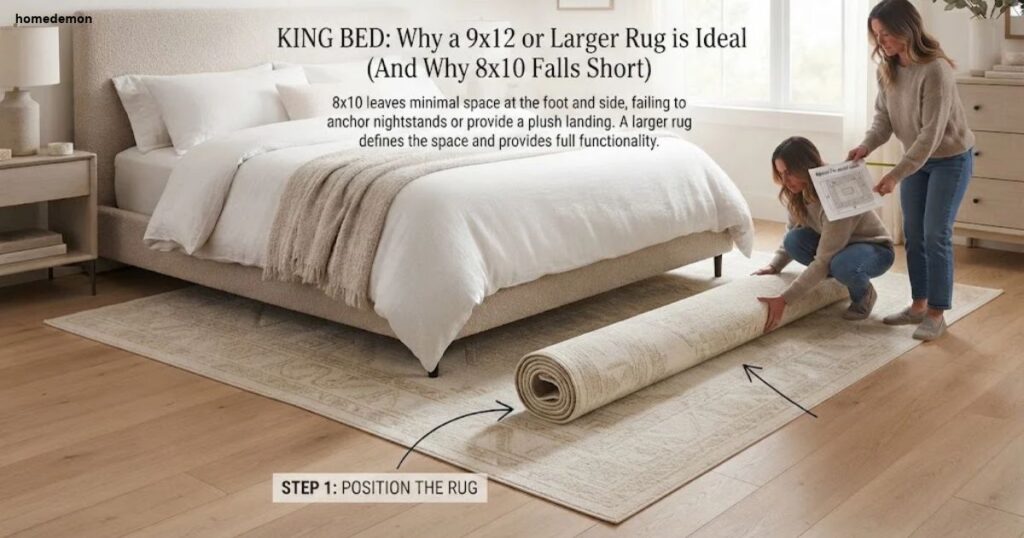
A standard king is 76 inches wide, which is only 16 inches wider than a queen. That small difference changes the answer completely.
An 8×10 under a king leaves just 10 inches on each side. That is well under the 18-inch guideline, and the rug looks tucked away. You can still use it with the 2/3 rule if budget is tight, but expect a modest result.
A 9×12 under a king gives about 16 inches per side. It is close to the target and is the size most designers recommend for a king bed. If your room can handle it, a 10×14 (120 x 168 inches) gives 22 inches per side and looks the most generous.
If you own a California king (72 x 84 inches), the width is between the queen and the standard king, so a 9×12 works well too.
Bedroom Area Rug Dimensions: The Size Chart
Here is the math in one place. “Foot” is how far the rug extends past the end of the bed.
| Bed | Rug | Each side | Foot (full coverage) | Foot (2/3 rule) |
|---|---|---|---|---|
| Queen (60 x 80) | 8×10 | 18 in | about 40 in | about 67 in |
| Queen (60 x 80) | 9×12 | 24 in | about 64 in | about 91 in |
| King (76 x 80) | 8×10 | 10 in | about 40 in | about 67 in |
| King (76 x 80) | 9×12 | 16 in | about 64 in | about 91 in |
| King (76 x 80) | 10×14 | 22 in | about 88 in | about 115 in |
These are approximate and assume the rug is centered side to side. The 2/3 rule pushes the rug about 27 inches toward the foot, which is why those numbers are larger.
The 2/3 Rule vs Full Coverage: Which Should You Choose?
Choose the 2/3 rule if:
- Your bedroom is small to medium and a huge rug would touch the walls.
- You want to save money. This layout works well with a rug one size smaller.
- You like seeing the wood floor near the headboard and nightstands.
- You sleep with the bed against a wall and rarely walk on that side.
Choose full coverage if:
- You want the softest landing when you step out of bed on either side.
- The room is large and a bigger rug will not feel crowded.
- You want the nightstands and bed to look like one grounded group.
- You are buying a 9×12 or larger anyway.
One warning about the 2/3 rule with an 8×10: the rug can stick out around five feet past the foot of a queen. In a tight room that pushes into the walkway or the dresser. If that happens, slide the rug closer to the headboard until the spacing feels balanced.
Step by Step: How to Place a Rug Under a Bed
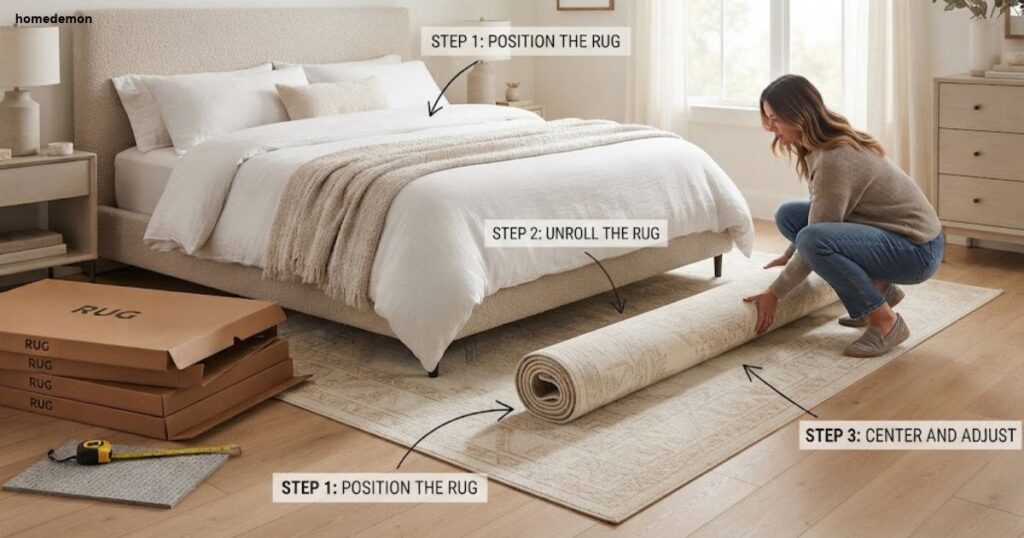
- Clear the room. Move the bed away from the wall enough to work. Take off nightstands and any bench.
- Lay the rug flat. Unroll it and let it settle for a few hours, especially if it was folded. Wrinkles make it hard to judge the position.
- Center the rug side to side. Measure both edges from the walls or the bed frame so the sides match.
- Decide your layout. For 2/3, slide the bed so the lower two-thirds rest on the rug. For full coverage, position the rug so the top edge is near the headboard.
- Lift the bed onto the rug. Get help. Lift the frame instead of dragging it, which can bunch or tear the rug.
- Check the sides and foot. Both sides should show equal rug. If you plan to add a bench at the foot, leave enough rug in front of it too.
- Add a rug pad. A pad stops sliding and adds cushioning. Pick one slightly smaller than the rug so the edges do not show.
- Put the nightstands back. With full coverage, all legs sit on the rug. With 2/3, keep them on bare floor or make sure they sit fully on or fully off.
Common Mistakes to Avoid
- Buying a 5×8 for a queen or king. It almost always looks too small.
- Placing the rug sideways. Keep the long side running the same direction as the bed.
- Letting only the front legs of furniture touch the rug. For the nightstands, all legs should be either on or off.
- Skipping the rug pad. The bed and daily traffic will shift the rug over time.
- Forgetting the door. Check that the rug does not stop the door from opening freely.
A Quick Word on Materials
Because the bed sits on part of the rug, choose something that handles weight and foot traffic. Low-pile and flatweave rugs are easiest to keep in place under bed legs. High-pile shag feels great underfoot, but heavy bed legs can crush it and it tends to shift more.
Neutral colors such as ivory, beige, and soft gray make the room feel calm, while a bolder pattern works well if your bedding is plain.
So, Which One Wins?
If you own a queen, an 8×10 is the safe answer, and a 9×12 is the luxury upgrade for bigger rooms. If you own a king, a 9×12 is the sweet spot, and an 8×10 only makes sense with the 2/3 rule and a smaller budget.
As for the layout, use 2/3 when space or money is tight, and full coverage when you want the fuller, more finished look. Measure your bed and room, subtract, and trust the numbers.
FAQ
Should a rug go under the whole bed?
Not necessarily. Full coverage looks polished, but the 2/3 layout is just as common and works better in smaller rooms.
How far should a rug stick out from a bed?
Aim for 18 to 24 inches on each side and at the foot, as a minimum.
Can I use two smaller rugs instead of one big one?
Yes. Two runners on either side of the bed work in narrow rooms, but a single rug usually looks cleaner.

Welcome to Home Demon! I’m Ameer Hamza, an SEO and Content Writing
Expert specializing in Guest Posting, with 3 years of experience.
I help websites rank higher, grow traffic, and look amazing. My goal
is to make SEO and web design simple and effective for everyone.
Let’s achieve more together!