

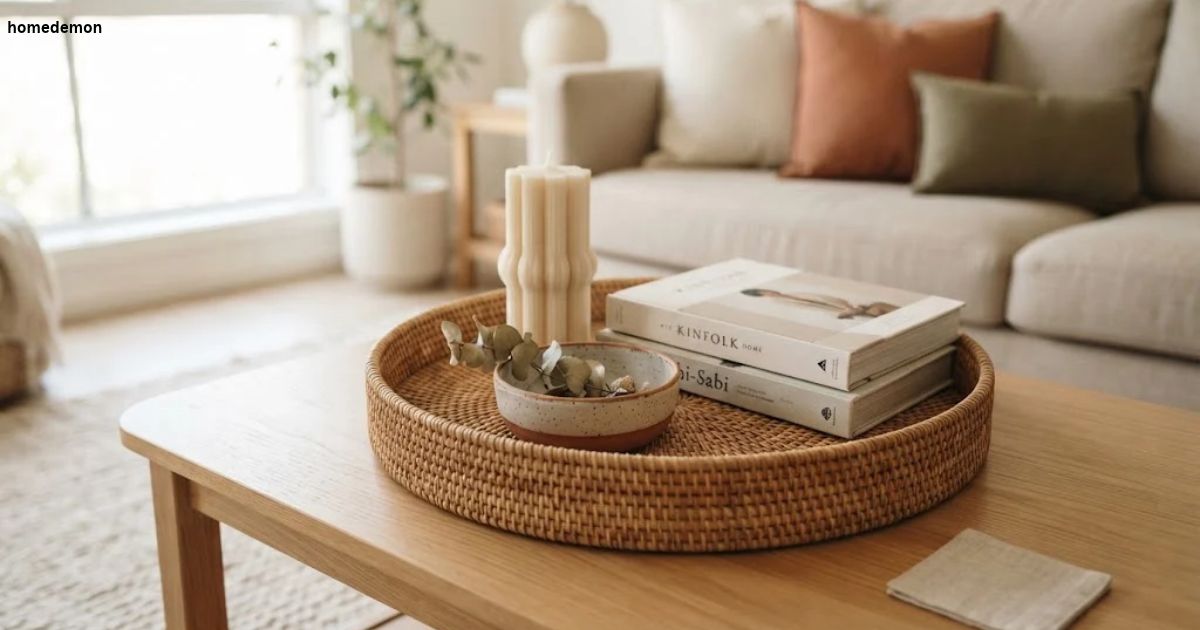
A bare coffee table feels unfinished. A crowded one feels chaotic. Somewhere in the middle is a table that looks calm, layered and lived-in, and the easiest way to get there is with a tray.
If you’ve been wondering how to style a coffee table with a tray, the good news is that you don’t need a designer’s eye. You need one simple principle: the rule of triangles. Once you understand it, you can style any coffee table in about ten minutes.
Why a Tray Makes Coffee Table Styling Easier
A tray does something quietly clever. It gives your objects a boundary. Instead of a scatter of items floating on a big surface, you get one defined group that reads as a single, deliberate arrangement.
It’s also practical. A tray keeps remotes, candles and small decor together, so tidying up means lifting one thing instead of five. And when you need the table for a snack or a laptop, you can move the whole tray aside.
The Rule of Triangles, Explained
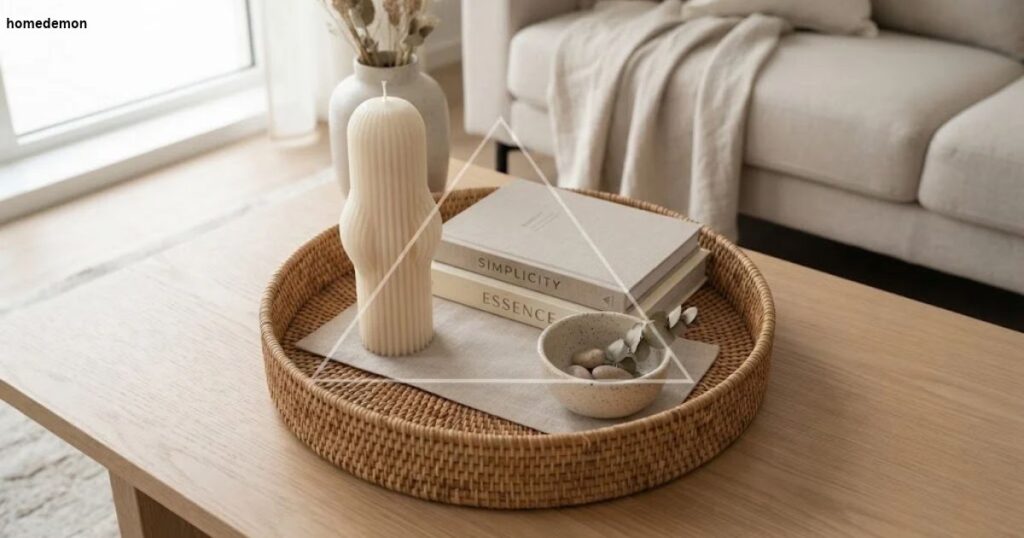
Here’s the idea behind almost every coffee table tray styling idea that works: arrange your objects so their tops form a triangle.
That means varying the height. Something tall, something medium and something low. When the eye travels across the group, it moves up and down rather than along a flat line, and that movement is what makes an arrangement feel styled.
Odd numbers help too. Three or five items look more natural than two or four, which tend to feel stiff and symmetrical.
The Four-Piece Formula
This is the modern coffee table decor formula I’d recommend to anyone starting out. It uses four pieces, and each one has a job.
1. A large textured tray (the foundation).
Choose a tray big enough to hold your group without crowding it, ideally covering roughly a third to half of the table surface. Texture matters here. Woven rattan, natural wood, marble or a matte lacquer all add depth. A plain glossy tray tends to disappear.
2. A sculptural candle (the tall point).
This is your highest element, so pick something with a shape worth looking at: a ribbed pillar, a sculpted vessel candle or an interesting holder. It doesn’t need to be lit to earn its place. Just keep the scent gentle if you do burn it, since it’s sitting right where people relax.
3. Stacked hardcover books (the medium anchor).
Two or three hardcovers stacked flat give you a solid mid-height base. Pick books with attractive spines or covers, in colors that fit your palette. Position them so the spines face out, and turn the largest to the bottom so the stack tapers upward.
4. A small ceramic bowl (the low point).
The bowl finishes the triangle. It sits low, adds a soft curve and can hold something useful, like coasters or a few decorative spheres. A handmade or lightly speckled piece looks especially good next to books and wood.
Put the candle at the back or one side, the books next to it, and the bowl in front and slightly to the side. Step back and check the silhouette. If you can trace a rough triangle from the candle down to the bowl, you’re there.
Coffee Table Tray Styling Ideas for Different Looks

The formula holds steady, but the materials change the mood.
Warm and organic: A rattan or wooden tray, a beeswax pillar candle, books with linen covers and a terracotta bowl.
Clean and modern: A matte black or marble tray, a geometric candle, neutral books and a white ceramic bowl.
Soft and cozy: A woven tray, a cream vessel candle, well-loved paperbacks in a stack and a small bowl in a muted earthy tone.
Bold and eclectic: A brass tray, a colored taper in a sculptural holder, art books with vivid covers and a patterned bowl.
Whichever direction you choose, keep to two or three colors so the group feels cohesive.
Decorating a Round Coffee Table
A round table changes the rules slightly. There are no corners to anchor your arrangement, so the tray becomes even more important.
Here’s what works:
- Use a round or oval tray. It echoes the shape of the table and looks intentional. A square tray can fight with the curves.
- Center it, or nudge it slightly. A centered tray feels calm and balanced. Shifting it a little off-center feels more casual, but leave enough surface for drinks.
- Cluster items toward one side of the tray. Rather than spreading items evenly, group them so the triangle sits to one side and the rest of the tray stays open.
- Keep heights modest. A round table is often viewed from all angles, so a very tall object can block conversation across the table.
If your round coffee table is small, skip the books and go with a candle and bowl for a simpler two-piece look. The triangle principle still applies, just on a smaller scale.
Rectangular Tables: Where to Place the Tray
On a rectangular table, you have two easy options. Center the tray for a symmetrical, formal feel, or place it toward one end so the other end stays clear for everyday use. Placing it off-center often looks more relaxed and modern, and it leaves room for a book you’re actually reading or a cup of tea.
Small Details That Make It Look Finished

A few extras take an arrangement from good to great:
- Add something living. A small stem in a bud vase or a tiny plant adds freshness. Just be careful not to exceed your tallest item.
- Mix matte and shiny. A glossy ceramic bowl against a matte tray, or a metallic accent beside natural wood, adds quiet contrast.
- Keep a little empty space. Don’t fill every inch of the tray. Breathing room is what makes the group feel curated.
- Use coasters. They keep the table protected, and a small stack in your bowl is both practical and tidy.
Common Coffee Table Styling Mistakes
Even with a tray, a few habits can undo the effect.
- Too many small objects. Lots of tiny things look like clutter. Choose fewer, larger pieces.
- Everything at the same height. A flat arrangement has no visual rhythm. Vary the heights.
- A tray that’s too small. A tiny tray on a big table looks lost. Go bigger than you think.
- Ignoring function. If you can’t put a drink down, the styling isn’t working. Leave room for real life.
- Never changing it. Swap a candle, a book or the bowl seasonally to keep the look fresh.
Quick Step-by-Step Recap
- Choose a textured tray that suits your table’s shape and size.
- Place your tall item, the sculptural candle, at the back or side.
- Add a stack of two or three hardcover books beside it.
- Position a small ceramic bowl low and in front to complete the triangle.
- Step back, check the silhouette and edit out anything that feels extra.
Frequently Asked Questions
How big should a coffee table tray be?
Aim for a tray that covers roughly a third to half of the table’s surface. Too small and it looks lost, too large and it leaves no room to use the table.
How many items should go on a coffee table tray?
Three to five is the sweet spot. The four-piece formula of a candle, books and a bowl on a tray works for most tables.
Can I use a tray on a round coffee table?
Absolutely. A round or oval tray works best, since it echoes the curve of the table.
Should I light the candles?
You can, but choose a soft scent, and always keep flames away from books and other flammable items.
How often should I restyle my coffee table?
Small swaps every few months, or with the seasons, keep it fresh without extra effort.
Final Thoughts
Learning how to style a coffee table with a tray really comes down to a single idea: build a triangle. A large textured tray, a sculptural candle, a stack of hardcover books and a small ceramic bowl give you height, weight and softness in one tidy group. Keep your palette tight, leave a little breathing room and adjust to suit your table’s shape.
Try it once, and you’ll never look at a bare coffee table the same way.

Welcome to Home Demon! I’m Ameer Hamza, an SEO and Content Writing
Expert specializing in Guest Posting, with 3 years of experience.
I help websites rank higher, grow traffic, and look amazing. My goal
is to make SEO and web design simple and effective for everyone.
Let’s achieve more together!