


Every small apartment has that one corner — the triangle of empty space between two walls that never seems to fit anything you already own. Standard furniture is built for straight walls, so corners tend to get written off as dead space, or worse, they become the spot where random stuff just piles up because there’s nowhere else to put it. That’s a shame, because living room corner storage ideas for small apartments can actually turn that ignored triangle into some of the most useful square footage in the whole room.
Why Corners Get Overlooked (And Why That’s a Mistake)
Most people furnish a living room by pushing pieces against the long, flat walls — sofa here, TV console there — and the corner just gets left out of the plan entirely. In a place with 500 to 900 square feet, though, skipping a usable corner means leaving storage on the table you genuinely need. Once you start treating corners as real storage opportunities instead of awkward leftover space, the whole room tends to feel more finished, not more cramped.
Corner Shelving Units: The Easiest Starting Point
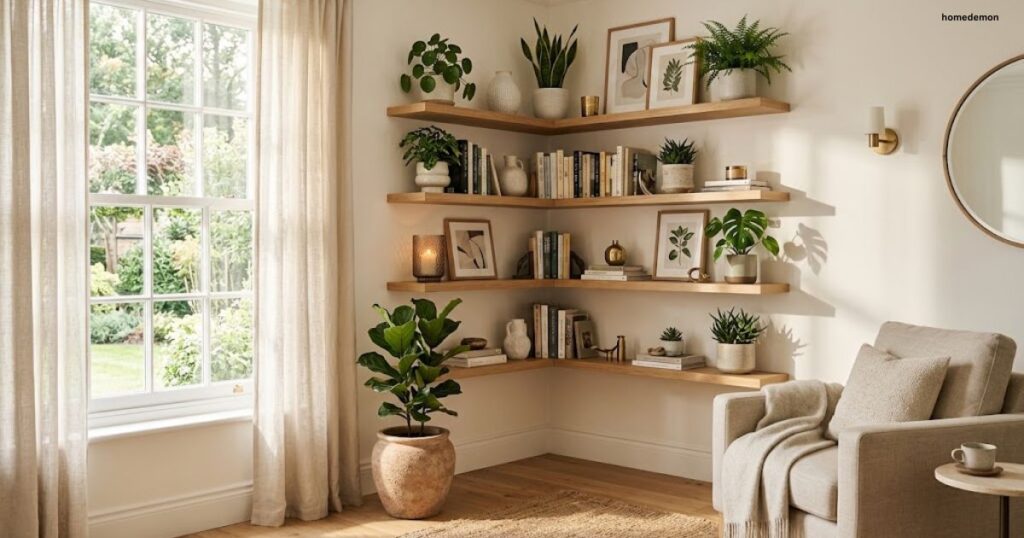
If you’re not ready to commit to a big furniture purchase, corner shelving units are the lowest-effort way to reclaim that space. A tall, narrow shelving unit designed specifically for corners keeps its footprint tight while still giving you several tiers of storage — books, plants, framed photos, whatever needs a home. Because these units are vertical rather than wide, they barely intrude on the walking space around them, which matters a lot in a room where every square foot is already accounted for.
Open shelving does come with one trade-off worth mentioning honestly: it shows everything. A shelf full of neatly stacked books looks intentional; a shelf full of mismatched chargers and mail does not. If you’re someone who tends to let things pile up, closed storage might serve you better than open shelves, even if open units look nicer in photos.
| Storage Type | Depth | Best For |
|---|---|---|
| Tall corner shelving unit | 10–14 inches | Books, plants, display items |
| Closed corner cabinet | 12–14 inches | Hiding daily clutter, cables, documents |
| Freestanding corner wardrobe | 20–24 inches | Clothing, linens, bulkier storage |
| Corner TV stand | 16–20 inches | Media, remotes, cable management |
Closed Cabinets for When You’d Rather Hide the Clutter
Not every corner needs to double as a display shelf. A closed corner cabinet, ideally somewhere around 12 to 14 inches deep, gives you a spot to stash things you use often but don’t necessarily want on view — cables, chargers, documents, the odd tangle of remote controls that seems to multiply on its own. The closed front does a lot of the visual heavy lifting here; it lets the corner stay functional without turning into one more thing you have to keep perfectly styled.
If you do use the top of a closed cabinet for decor, resist the urge to fill it with five small objects. One lamp, one plant, or a single framed photo tends to look far more intentional than a cluttered little collection competing for attention.
Living Room Storage Furniture That Actually Fits a Corner
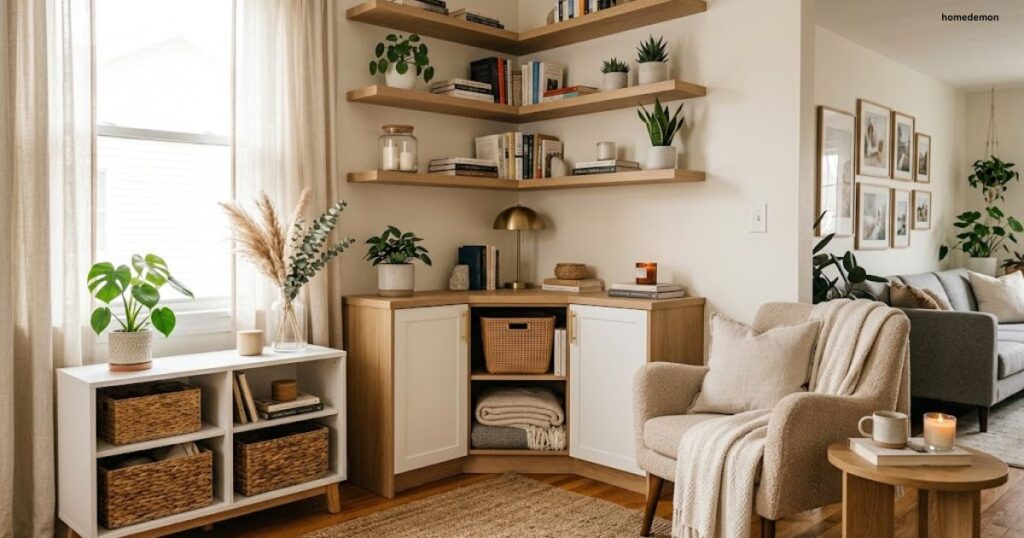
Beyond basic shelving, there’s a whole category of living room storage furniture built specifically to work with two walls instead of one. A freestanding corner bookcase, for example, often has a triangular back panel designed to sit flush against both walls, which gives it a built-in look without any actual construction involved — genuinely useful if you’re renting and can’t modify the space.
For anyone dealing with a lack of closet space, a freestanding corner wardrobe is worth considering too. These combine hanging space and shelving in one compact footprint, addressing a storage gap that a simple shelf can’t really solve on its own.
Using the Corner for Media Setups
Corners aren’t just for shelving — they can work well for a television, too. Angling a TV into the corner, rather than mounting it flat against one wall, can actually improve sightlines from multiple seating spots in a small living room, especially in an oddly shaped space where a straight-wall setup leaves someone squinting sideways. A slim corner TV stand keeps cables organized and out of view, which matters more in a small room where a tangle of wires is a lot harder to hide.
Renter-Friendly Options When You Can’t Drill Into Anything
If your lease means no wall-mounted shelves and no drilling, freestanding pieces are your best bet. A corner bookcase, wardrobe, or cabinet that simply sits in place moves with you when your lease ends, and none of it requires touching the walls at all. This is honestly one of the more practical advantages of corner furniture over built-in solutions — it gives you the finished look of custom storage without any of the commitment.
Don’t Forget Lighting and Comfort, Not Just Storage
Storage isn’t the only thing a corner can offer. Some of the most underused corners work better as a small reading nook — a comfortable chair, a narrow side table, and a floor lamp can turn dead space into the most-used seat in the apartment. If your corner sits near a window, this is often a better use of the space than cramming in another shelving unit, especially if storage isn’t your biggest problem in that particular room.
A Few Things to Measure Before You Buy Anything
Corners come with quirks that flat walls don’t — a nearby outlet, a heating vent, a window that limits how tall something can be. Before buying any corner piece, check the actual depth available on both walls, not just one, since most corner furniture is designed to sit flush against both sides evenly. It’s also worth checking that whatever you choose doesn’t block a heating vent or outlet you actually need access to, which is an easy detail to miss when you’re focused on how a piece looks in photos.
Frequently Asked Questions
What’s the best type of corner storage for a small apartment? It depends on what you’re storing. Open corner shelving units work well for books and display items, while closed cabinets are better if you’d rather hide daily clutter like cables and documents.
Can I add corner storage in a rental without drilling into the walls? Yes. Freestanding corner shelving units, bookcases, and wardrobes don’t require any wall mounting, which makes them a practical option for renters who need everything to move out with them later.
Is it better to use a living room corner for storage or seating? It depends on the room. If storage is your biggest challenge, a shelving unit or cabinet makes sense. If the corner gets good natural light and you already have enough storage elsewhere, a small reading nook can be the more useful choice.
Styling the Corner So It Doesn’t Look Like an Afterthought
Even the most functional corner storage can end up looking awkward if it’s styled as a last-minute addition rather than an intentional part of the room. A quick way to fix that is to echo a color or material already used elsewhere in the living room — if your coffee table is a warm wood tone, a matching wood-finish corner shelf ties the whole space together instead of looking like it was picked separately. Height matters too. A piece that stops noticeably shorter than nearby furniture can look stunted, while one that towers well above everything else can make a small room feel more cramped than it actually is. Aiming for something roughly in line with your tallest existing piece usually keeps the proportions feeling balanced.
Final Thoughts
That empty triangle in the corner of your living room is worth more attention than most apartments give it. Whether you go with a tall corner shelving unit, a closed cabinet to hide the daily clutter, or a piece of living room storage furniture built specifically for two walls, the goal is the same — stop treating the corner as leftover space and start treating it as real square footage. A little planning here goes a long way toward making a small apartment feel more organized without losing an inch of actual living space.

Welcome to Home Demon! I’m Ameer Hamza, an SEO and Content Writing
Expert specializing in Guest Posting, with 3 years of experience.
I help websites rank higher, grow traffic, and look amazing. My goal
is to make SEO and web design simple and effective for everyone.
Let’s achieve more together!