

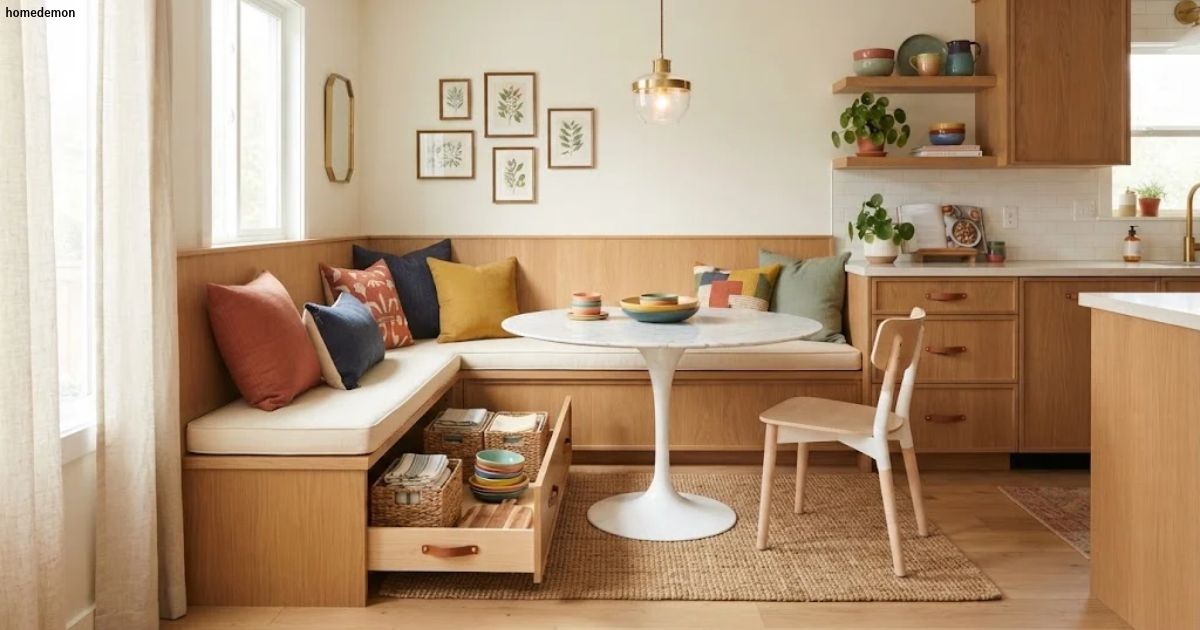
If your kitchen is tight, the corner is the most valuable spot you aren’t using. Fill it with a built-in bench and a slim table, and it becomes the place where everyone eats, talks, and does homework.
These small kitchen breakfast nook bench seating ideas all build on one winning pair: a built-in corner bench with lift-up hidden storage, and a tulip pedestal table that keeps your walkway open. Below, you’ll find how it works, what to measure, what it costs, and how to avoid the usual mistakes.
Why This Combination Works
Most small kitchens have two problems at once: not enough seats and not enough storage. A corner bench with a lift-up seat solves both. It seats three or four people in the footprint of two chairs, and the space under the seat holds things you’d otherwise squeeze into cabinets.
The tulip table solves a third problem, which is movement. A pedestal base has no legs to bump, so you slide in from any direction and walk around the table without catching your shins. In a small room, that matters more than almost anything else.
Measure Before You Build
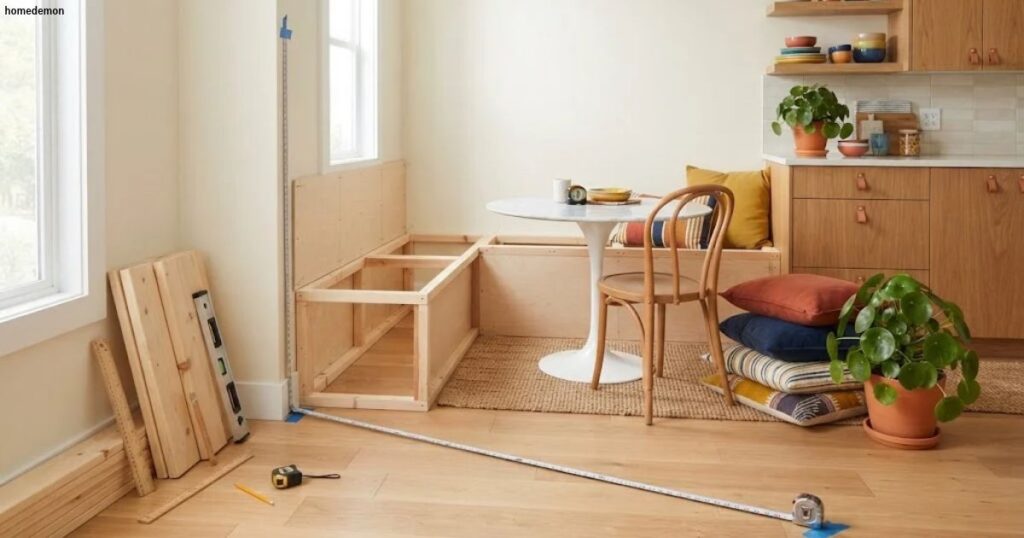
Get a tape measure and write these numbers down. They’re common guidelines, so adjust them for your family.
- Seat height: 17 to 19 inches
- Seat depth: 16 to 18 inches (deeper eats walkway)
- Seat width per person: 20 to 24 inches
- Space between seat and tabletop: 10 to 12 inches
- Walkway behind the table: at least 30 to 36 inches where people pass
A good trick is to mark the bench and table on the floor with painter’s tape. Live with it for a day or two before you commit to anything.
1. The Built-In Corner Bench With Lift-Up Hidden Storage
This is the star of the show. Two L-shaped benches fit snugly into a corner, and each seat lifts up like a lid to reveal a deep storage compartment underneath.
Why build it in, rather than buy a freestanding bench? A built-in fits your exact corner with no wasted gaps, and it can include a proper backrest. A corner breakfast nook with storage like this is also sturdy enough to hold several adults without wobbling.
Here’s what typically goes inside:
- Table linens, placemats, and trays
- Holiday dishes and serving platters
- Rarely used small appliances, such as a waffle maker or slow cooker
- Pet supplies, lunch boxes, or reusable bags
Divide the space into two or three sections with plywood dividers. Otherwise everything slides into one jumbled pile.
2. Plan the Lift-Up Storage Carefully
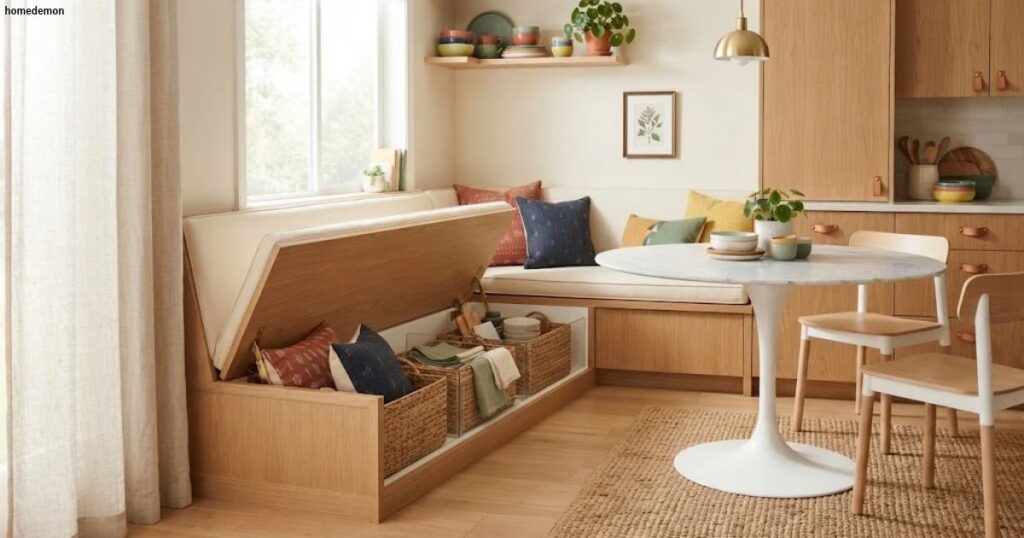
Hidden storage is only useful if it’s easy to reach and safe to use. A few details make the difference.
Use soft-close hinges or lid supports. A heavy seat that slams shut on fingers is a real hazard, especially with kids around. Soft-close stays or gas struts hold the lid open and lower it gently.
Keep the lid light enough to lift. A lid with a thick cushion on top adds weight. If you’re building it yourself, use 3/4 inch plywood and avoid anything heavier than you need.
Allow some airflow. A small gap or ventilation hole prevents the stale smell that can build up in a closed box, particularly in a kitchen.
Think about access. You’ll need to move the seat cushion to open the lid, so pick a cushion that slides off easily or attach it with a few simple ties.
3. The Tulip Pedestal Table
The tulip table is named for its single curved base, which looks like the stem of a flower. It sits in the center of the top, so no leg ever gets in the way of the bench.
Look for a round top between 30 and 36 inches across. That size seats two comfortably and four with a bit of squeezing, and it leaves breathing room around the table in a small kitchen. An oval is a good alternative if the nook is longer than it is wide.
Materials matter in a kitchen. White laminate is cheap and easy to wipe, while wood adds warmth and marble or a marble-look surface feels upscale. A simple pedestal table often costs between $120 and $400, depending on the material.
4. Do the Walkway Math
Here’s why the pair works so well. A table with four legs forces you to leave room around each leg and chair. A tulip table has one base in the center, so you can place the bench closer and still slide in without scraping.
That means you can often shift the whole nook an extra few inches toward the corner. It sounds minor, but those inches are the difference between a comfortable path to the fridge and an annoying squeeze.
5. Kitchen Banquette Seating for Small Spaces
No corner? A straight banquette along one wall gives you a similar result. Kitchen banquette seating small spaces can handle works well under a window, at the end of a galley kitchen, or beside a doorway.
Keep the same lift-up lid idea along the seat. Pair the banquette with two chairs or stools on the open side, so you can seat four when guests arrive and tuck the chairs away when you don’t need them.
6. A Bistro Breakfast Nook for Tiny Footprints

If you have just a few feet to spare, scale everything down. A bistro breakfast nook uses a narrow bench for two against the wall and a small round tulip table in front, like a cafe corner.
It suits an apartment kitchen or a little alcove. You still get hidden storage if the bench has a lift-up seat, and a pair of pillows and a small pendant make it feel like your own coffee spot.
7. Cushions and Fabric That Last
Hard wood gets uncomfortable fast, so add a cushion of 2 to 3 inches. In a kitchen, choose something you can clean easily:
- Performance fabric resists stains and wipes up well
- Vinyl or faux leather cleans in seconds
- Removable, washable covers are best for families with kids
Add a couple of back pillows if there’s no built-in backrest. Neutral colors like warm gray or sage blend with most cabinets, and you can add personality with a patterned pillow.
8. Lighting and Simple Decor
A nook feels special when it has its own light. Hang a pendant about 30 to 36 inches above the tabletop, centered over the pedestal. If you can’t wire one, a plug-in swag lamp works just as well.
Keep decor minimal: one framed print, a small plant, or a mirror to bounce light. In a small space, less looks better.
What It Costs
| Option | Typical Cost |
|---|---|
| DIY corner bench (materials only) | $150 to $400 |
| Custom built-in with a carpenter | $1,500 to $4,000+ |
| Tulip pedestal table | $120 to $400 |
| Seat cushions and fabric | $60 to $200 |
| Pendant light | $40 to $150 |
These are general ranges, and prices vary by region and materials, so check current quotes and listings before you budget.
Mistakes to Avoid
- Building the bench too deep. Past 18 inches, it starts to eat the walkway.
- Skipping the lid hardware. Without soft-close supports, lids can slam shut.
- Choosing a table that’s too large. Leave room to slide in and out.
- Forgetting about light. A dark nook gets used less.
- Using hard-to-clean fabric. Crumbs and spills are guaranteed.
Frequently Asked Questions
How much space do I need for a corner breakfast nook?
A small nook can fit in about a 5 by 5 foot corner, though a bit more makes it more comfortable.
Can I add lift-up storage without building anything?
Yes. Many ready-made storage benches have hinged seats. They’re cheaper and movable, though they won’t fit a corner as precisely as a built-in.
Why use a tulip table instead of a regular one?
It has a single center base, so there are no legs to bump into, and it takes up less visual and physical space.
How big should a round table be for a small nook?
Between 30 and 36 inches across works for most small kitchens.
Final Thoughts
A small kitchen can still have a great place to sit. A built-in corner bench with lift-up storage gives you seats and room for the things that clutter your cabinets, and a tulip table keeps your path clear. Measure carefully, plan the hardware, and your corner will become the favorite spot in the house.

Welcome to Home Demon! I’m Ameer Hamza, an SEO and Content Writing
Expert specializing in Guest Posting, with 3 years of experience.
I help websites rank higher, grow traffic, and look amazing. My goal
is to make SEO and web design simple and effective for everyone.
Let’s achieve more together!