

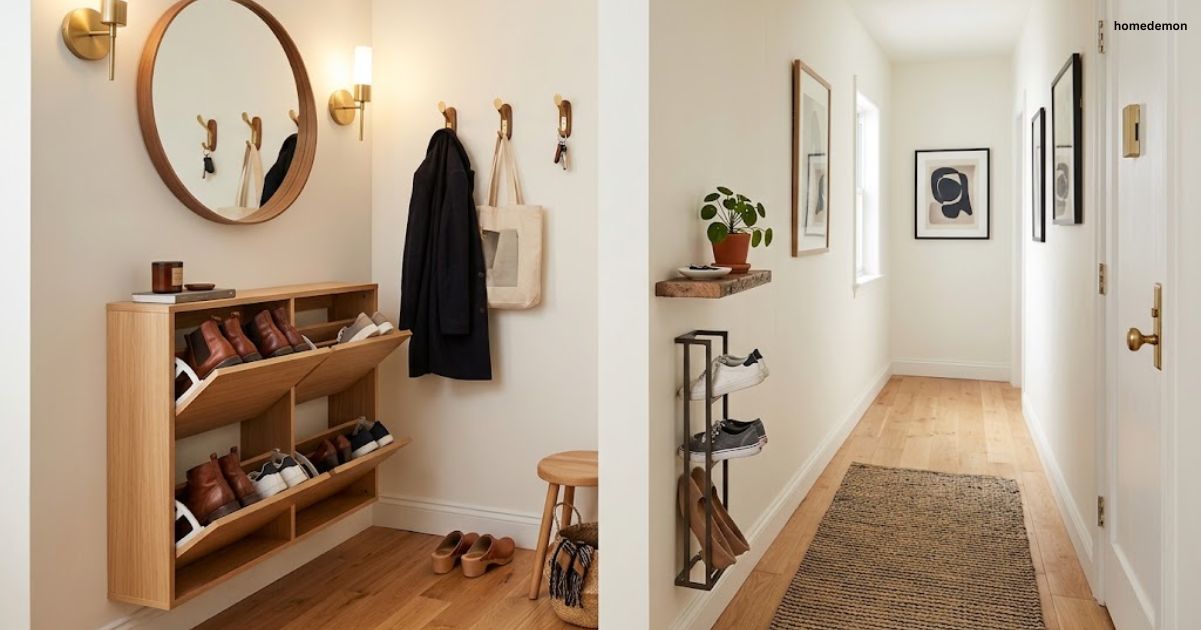
If your front door opens straight into a hallway that’s barely wide enough for two people to pass each other, you already know the struggle of finding somewhere for shoes to go. Wide shoe cabinets and bulky benches just aren’t an option when there’s only a foot or two of clearance to work with. The good news is that entryway shoe storage ideas for narrow hallway spaces don’t have to mean sacrificing either function or style — you just need to think in terms of depth and height instead of width.
Measure Before You Fall in Love With Anything

This sounds obvious, but it’s the step most people skip, and it’s the reason so many narrow hallway storage attempts end up returned or shoved in a closet within a month. Before buying anything, measure the actual clear walking width of your hallway — not just the space near the door, but the full path someone walks when carrying groceries or a stroller through it. A piece that technically fits against the wall can still make the hallway feel cramped if it eats into that walking clearance.
Go Narrow, Not Wide
The single biggest shift in thinking here is choosing depth over width. A traditional shoe cabinet might be 15-18 inches deep, which simply won’t work in a tight hallway. Slim shoe cabinet ideas solve this by cutting depth down to under 10 inches in many cases, while still holding a surprising number of pairs by stacking them vertically instead of spreading them out.
Look specifically for cabinets described as “slim” or “narrow” rather than standard entryway furniture — the difference in depth between a regular shoe cabinet and a slim one can be the difference between a piece that fits and one that doesn’t.
| Storage Type | Typical Depth | Shoe Capacity |
|---|---|---|
| Standard shoe cabinet | 15–18 inches | 15–25 pairs |
| Slim shoe cabinet | 9–10 inches | 12–20 pairs |
| Vertical tower rack | 12–14 inches | 15–30 pairs (tall) |
| Flip-drawer narrow cabinet | 9–10 inches | 12–16 pairs |
Build Up Instead of Out
When floor width is your limiting factor, height becomes your best friend. A tall, vertical shoe tower takes up roughly the same footprint as a single pair of shoes sitting on the floor, but it can hold ten times that once you stack tiers. This approach works especially well for apartments and older homes, where hallways tend to run narrower than in newer construction.
If you’re worried about a tall piece making the space feel closed in, an open-shelf tower — rather than a solid cabinet — tends to keep the hallway feeling airier, since light and sightlines aren’t fully blocked.
Flip-Down Drawers Are a Genuinely Clever Fix
One of the more underrated options for tight spaces is a cabinet with flip-down drawers instead of a swinging door. Because the drawer front tilts open rather than swinging outward on a hinge, it barely eats into the walking path when you’re grabbing a pair of shoes — which matters a lot when a regular cabinet door would otherwise block the entire hallway while it’s open. These cabinets are also usually built specifically at that narrow 9-to-10-inch depth, so form and function line up nicely here.
Narrow Foyer Storage That Isn’t Furniture at All
Not every solution needs to be a standalone piece. Narrow foyer storage can be as simple as a slim shelf mounted above a radiator, a row of hooks with a small tray underneath for shoes waiting to be put away, or a shallow shoe rack tucked behind the front door itself — a spot most people never think to use. Over-the-door organizers, usually sold for closets, work just as well mounted on the back of an entry door for flip-flops, slippers, or shoes that get worn daily.
Separate “Everyday” Shoes From Everything Else

A narrow hallway simply can’t hold every pair your household owns, and trying to force that usually results in a cluttered mess regardless of how nice the storage piece is. Keep only the shoes worn in the current season, or in the last week or two, in the entryway itself. Everything else — winter boots in summer, rarely worn dress shoes — belongs somewhere else in the house, like a bedroom closet or a bin under a bed. This one habit does more for a tidy entryway than any storage purchase ever will.
Don’t Forget the Walking Clearance Rule
It’s worth repeating, because it’s the detail that makes or breaks a narrow hallway setup: whatever you choose, it should never force anyone to turn sideways or step around it to get through the door. If a piece of furniture makes the hallway harder to walk through than it was with shoes just piled on the floor, it’s not actually solving the problem — it’s just relocating it.
A Few Budget-Friendly Options Worth Trying First
If you’re not ready to commit to furniture yet, a few low-cost options are worth testing before you buy anything permanent. A slim wicker basket by the door holds a handful of everyday pairs without needing any assembly. A stick-on wall hook rail, mounted at a low height, can hold slides or sandals off the floor entirely. And a thin rubber tray, tucked flush against the baseboard, at least contains the mess even if it doesn’t fully organize it — a reasonable first step while you figure out what permanent solution actually fits your space.
Frequently Asked Questions
What’s the best depth for a shoe cabinet in a narrow hallway? Look for cabinets in the 9-to-10-inch depth range, often labeled as slim or narrow shoe cabinets, since standard cabinets are usually too deep to fit without blocking the walking path.
How many shoes can a narrow shoe cabinet actually hold? Most slim cabinets hold somewhere between 12 and 20 pairs depending on the number of tiers or drawers, which is often enough for a household’s everyday rotation even in a tight space.
Is vertical storage better than a wide shoe rack for tight hallways? In most narrow hallways, yes — a tall, narrow unit uses far less floor width than a wide rack while often holding a comparable or greater number of pairs.
Final Thoughts
Finding workable entryway shoe storage ideas for narrow hallway spaces really comes down to one shift in mindset: stop looking for wide furniture and start looking for tall, slim, or flip-open options instead. Measure first, keep the walking path clear no matter what you choose, and don’t be afraid to store off-season shoes elsewhere in the house. Once the space is only holding what actually gets used, even the tightest hallway starts to feel a lot less chaotic.

Welcome to Home Demon! I’m Ameer Hamza, an SEO and Content Writing
Expert specializing in Guest Posting, with 3 years of experience.
I help websites rank higher, grow traffic, and look amazing. My goal
is to make SEO and web design simple and effective for everyone.
Let’s achieve more together!