


Warm minimalist home decor keeps a room simple but makes it feel soft. You use fewer things, pick earthy neutral colors, and add natural materials like linen, wood, and stone. The result is a calm home that is also cozy to sit in.
This guide shows you how to get the look step by step. You will learn four key ideas: neutral linen textures, curved wood furniture, travertine accents, and tone-on-tone layering. You will also see how warm minimalism is different from organic modern style.
What Is Warm Minimalism?

Warm minimalism mixes the clean look of minimalism with natural comfort. Designer Molly Torres Portnof told Homes & Gardens that it pairs simplicity with earthy tones, layered textures, and natural materials. The same article describes it as “less but better.”
Traditional minimalism often relies on white walls, glass, chrome, and marble. Warm minimalism swaps these for soft textiles, organic wood, and earthy colors, as Raft Furniture explains in its trend guide.
Three simple rules sit behind the style:
- Own fewer things, but choose better ones.
- Pick natural materials over shiny, man-made ones.
- Add warmth with texture and soft light, not with clutter.
Warm Minimalism vs Organic Modern

People often mix up these two styles because they look alike at first glance. Both use clean lines and natural materials. The difference is in how much contrast and shape they add.
- Warm minimalism is the calmer base. It stays quiet, soft, and tightly edited.
- Organic modern adds more contrast and a few bold shapes. Havenly says it often includes an architectural light fixture or a statement chair, while the rest of the furniture stays low and simple.
One designer quoted by The Zoe Report calls organic modern an evolution of warm minimalism. A helpful way to see it: start with warm minimalism, then add a little more contrast if you want more personality.
Build the Palette With Tone-on-Tone Layering
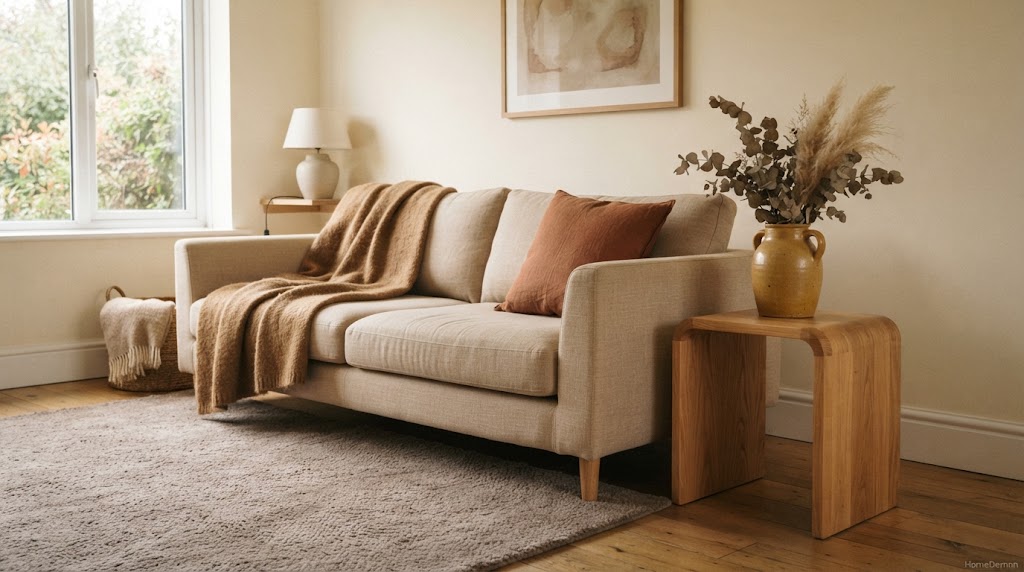
Tone-on-tone layering means using different shades of one color family in the same room. In a warm minimalist home, that family is usually a soft neutral. Rossetti Art lists sand, oat, clay, and soft charcoal as a typical palette, in place of pure white and pure black.
Here is a simple way to do it:
- Pick one base color. Warm cream or oat works well on walls.
- Add two more shades. Choose one lighter and one deeper, such as sand and soft taupe.
- Change the texture, not the color. A smooth linen sofa, a chunky wool throw, and a woven basket can all be beige and still look rich.
- Use one dark accent. A soft charcoal lamp or picture frame gives the eye a place to rest.
If every layer has the same texture, the room looks flat. Texture is what makes a neutral room feel alive.
Neutral Linen Textures
Linen is the easiest way to bring warmth into a simple room. It looks relaxed, it softens harsh light, and it gets softer after each wash.
Designers quoted by Homes & Gardens like to embrace small imperfections, including naturally creased linens. You do not need to iron everything. A little wrinkle adds to the lived-in feel.
Where to use linen:
- Curtains: Light oat or ivory linen curtains let sunlight through and make the window feel soft.
- Bedding: Linen sheets in sand or stone create a calm bed with little effort.
- Sofa and chairs: A linen slipcover or a linen-look fabric keeps the sofa from feeling stiff.
- Small items: Cushion covers, table runners, and napkins are low-cost ways to try the look.
For more depth, mix linen with another soft fabric. Rossetti Art names bouclé and linen as a common pairing in warm minimalist rooms. Keep patterns to a minimum. If you want a pattern, choose a subtle stripe or a woven texture in the same color.
Curved Wood Furniture

Straight lines can make a minimalist room feel strict. Curves fix that. A Gazette home feature notes that subtle curves in chair backs and table bases stop a streamlined design from looking rigid.
Good curved wood pieces to look for:
- A round or oval dining table
- Dining chairs with a curved back
- A rounded coffee table or a pair of small nesting tables
- An arched mirror frame or a curved wooden bench
- Wooden bowls, trays, and sculptural decor
Walnut and light oak both fit the style. Rossetti Art lists raw wood and walnut among warm minimalist materials. Try to keep to one or two wood tones in a room. Too many shades make the space look busy, which goes against the style.
Leave some space around each piece. A curved chair looks best when you can see its full shape.
Travertine Accents

Travertine is a natural stone with soft cream and beige tones. Rossetti Art includes travertine in its list of warm materials, next to linen, walnut, and terracotta. It adds a calm, earthy touch without feeling cold like polished marble or chrome.
You do not need a stone table to get the look. Small accents are enough:
- A travertine tray on the coffee table or bathroom counter
- A side table or lamp base
- A bowl, candle holder, or small sculpture
- Travertine-look tiles for a bathroom wall or kitchen backsplash
A practical tip: travertine is a porous stone, so it can stain or lose its shine if acidic liquids like lemon juice or wine sit on it. Seal real travertine and wipe spills fast. If that sounds like too much care, look for travertine-look pieces in ceramic or resin.
Use Lighting as a Design Material

Light is part of the design, not an extra. Castlery’s guide on warm minimalism says lighting should be planned from the start. Homes & Gardens also points out that fans of the style avoid cool, harsh bulbs.
Simple lighting tips:
- Use warm white bulbs. Look for 2700K to 3000K on the box.
- Layer your light with a floor lamp, a table lamp, and one softer overhead source.
- Choose linen or paper shades to spread light gently.
- Keep windows clear so natural light can reach the room.
Warm Minimalism Interior Design Ideas, Room by Room

Living room: Start with a sand or oat sofa. Add a curved wood coffee table, a wool rug in a slightly deeper shade, and linen curtains. Finish with one travertine tray and one plant.
Bedroom: Use linen bedding in two close shades. Choose a simple wood bed frame, a small bedside table with a rounded edge, and a warm lamp on each side. Keep the walls bare or hang one large, calm artwork.
Dining area: A round wood table with curved-back chairs is the easiest way to soften the space. Add a linen table runner and a single ceramic vase.
Bathroom or entryway: A travertine shelf or tray, a wooden stool, and a linen towel in oat are enough to get the feeling.
You can start small. The Gazette feature on this style notes that you can get the look without a full renovation or a big budget. Textiles and small accents are the cheapest place to begin.
Common Mistakes to Avoid
Castlery warns that warm minimalism looks simple, which is exactly why it is easy to get wrong. Watch out for these:
- Going too bare. Fewer things does not mean no softness. If the room feels cold, add texture.
- Using one flat texture. A room full of smooth beige surfaces looks dull. Mix linen, wood, wool, and stone.
- Matching everything. Pieces that are too perfectly matched look like a showroom. Let the shades and woods differ a little.
- Using cool white light. It can ruin even a perfect palette. Switch to warm bulbs first.
- Buying everything at once. Build slowly. Live with the room for a few weeks and add only what it needs.
Quick Start Checklist
- Choose one neutral base color and two nearby shades.
- Swap in linen curtains or bedding.
- Add one curved wood piece.
- Place one travertine accent.
- Change cool bulbs to warm ones.
- Remove anything that does not look good or serve a purpose.
Frequently Asked Questions
What is warm minimalist home decor?
Warm minimalist home decor is a style that keeps rooms simple and uncluttered but adds comfort through earthy colors, natural materials, and layered textures like linen, wood, and stone.
What colors work best for a warm minimalist home?
Soft, earthy neutrals work best. Think sand, oat, cream, clay, taupe, and soft charcoal. Avoid stark white and pure black, and layer different shades of the same family.
What is the difference between organic modern and warm minimalist style?
Both use clean lines and natural materials. Warm minimalism is quieter and more tightly edited. Organic modern adds more contrast, such as a statement light or chair, and a wider mix of shapes and textures.
Is warm minimalism expensive to create?
Not necessarily. You can start with low-cost items such as linen cushion covers, warm bulbs, and a small tray. Add larger pieces like curved wood furniture over time.
Is travertine hard to take care of?
Real travertine is porous, so it should be sealed and wiped clean quickly after spills, especially from acidic liquids. If you want a low-effort option, choose travertine-look decor made from ceramic or resin.
How do I add warmth without adding clutter?
Use texture and light instead of extra objects. Linen fabrics, a wool throw, a wooden bowl, and warm bulbs add comfort without crowding the room.
Sources
- Homes & Gardens: Warm minimalism decor trend
- Castlery: Warm Minimalism: How to Create Calm, Inviting Spaces
- Raft Furniture: Warm Minimalism: Interior Design Trend of 2022
- Rossetti Art: Warm Minimalism Interior Design: The Complete Guide
- The Gazette: Effortlessly Elevate with Warm Minimalism Design
- Havenly: Is “Organic Modern” the New Warm Minimalism?
- The Zoe Report: Your guide to the “organic modern” look

Welcome to Home Demon! I’m Ameer Hamza, an SEO and Content Writing
Expert specializing in Guest Posting, with 3 years of experience.
I help websites rank higher, grow traffic, and look amazing. My goal
is to make SEO and web design simple and effective for everyone.
Let’s achieve more together!